Showing posts with label A Castle Bromwich Herbiary. Show all posts

27/03/2013

A Castle Bromwich Herbiary - Chives


A Castle Bromwich Herbiary - Chives


purple flower sinks ~
bumble bee lights on a chive ~
river of summer


Botanical: Allium schoenoprasum
Family: N.O. Liliaceae
(French) Ail civitte
(Old French) Petit poireau

The Chive is the smallest, though one of the finest-flavoured of the Onion variety, belonging to the botanical group of plants that goes under the name of Allium, which also includes Garlic, Leek and Shallot. 

Allium schoenoprasum - Original book source: Prof. Dr. Otto Wilhelm Thomé ''Flora von Deutschland, Österreich und der Sc. Public Dom

General:

Though said to be a native of Britain, the Chive is only very rarely found growing in an uncultivated state, and then only in the northern and western counties of England and Wales and in Oxfordshire. It grows in rocky pastures throughout temperate and northern Europe. De Candolle says: 'This species occupies an extensive area in the northern hemisphere. It is found all over Europe from Corsica and Greece to the south of Sweden, in Siberia as far as Kamschatka and also in North America. The variety found in the Alps is the nearest to the cultivated form.' Most probably it was known to the Ancients, as it grows wild in Greece and Italy. Dodoens figures it and gives the French name for it in his days: 'Petit poureau,' relating to its rush-like appearance. 

In present day French it is commonly called 'Ail civitte.' The Latin name of this species means 'Rush-Leek.' 

The plant is a hardy perennial. The bulbs grow very close together in dense tufts or clusters, and are of an elongated form, with white, rather firm sheaths, the outer sheath sometimes grey.

The slender leaves appear early in spring and are long, cylindrical and hollow, tapering to a point and about the thickness of a crowsquill. They grow from 6 to 10 inches high.

The flowering stem is usually nipped off with cultivated plants (which are grown solely for the sake of the leaves, or 'grass'), but when allowed to rise, it seldom reaches more than a few inches to at most a foot in height. It is hollow and either has no leaf or one leaf sheathing it below the middle. It supports a close globular head, or umbel, of purple flowers; the numerous flowers are densely packed together on separate, very slender little flower-stalks, shorter than the flowers themselves, which lengthen slightly as the fruit ripens, causing the heads to assume a conical instead of a round shape. 

Allium schoenoprasum. Photograph by Fornax.
 
The petals of the flowers are nearly half an inch long; when dry, their pale-purple colour, which has in Parts a darker flush, changes to rose-colour. The anthers (the pollen-bearing part of the flower) are of a bluish-purple colour. The seed-vessel, or capsule, is a little larger than a hemp seed and is completely concealed within the petals, which are about twice its length. The small seeds which it contains are black when ripe and similar to Onion seeds.

The flowers are in blossom in June and July, and in the most cold and moist situations will mature their seeds, though rarely allowed to do so under cultivation.

Chives can be found in Castle Bromwich Hall Gardens in various areas, usually in the borders around the Batty Langley Kitchen Garden. 


Cultivation:

Seeds of ''Allium schoenoprasum''. Squares have a length of 5 mm. Photograph by Sarefo

Chives will grow in any ordinary garden soil, but will thrive in soil rich in organic matter, with a pH of 6-7 and full sun. Typically, chives need to be germinated at a temperature of 15 to 20°C (60-70°F) and kept moist. They can also be planted under a cloche or germinated indoors in cooler climates, then planted out later. Chives can be raised by seed, but are usually propagated by dividing the clumps in spring or autumn. 

In dividing the clumps, leave about six little bulbs together in a tiny clump, which will spread to a fine clump in the course of a year. Set the clumps from 9 inches to a foot apart each way. For a quick return, propagation by division of the bulb clumps is always to be preferred.

Chives are cultivated both for their culinary uses and their ornamental value; the violet flowers are often used in ornamental dry bouquets.

In cold regions, chives die back to the underground bulbs in winter, with the new leaves appearing in early spring. Chives starting to look old can be cut back to about 2–5cm. When harvesting, the needed number of stalks should be cut to the base. During the growing season, the plant will continually regrow leaves, allowing for a continuous harvest.

Chive seedlings sprouting. Photograph by Norman21

The green from the clumps can be cut three or four times in the season. When required for use, each clump may be cut in turn, fairly close to the ground. The leaves will soon grow again and be found more tender each time of cutting. By carefully cropping, the 'grass' can be obtained quite late in the season, until the early frosts come, when it withers up and disappears through the winter, pushing up again in the first warm days of February. For early crops, a little 'grass' can be forced on the clumps by placing cloches or a 'light' over them.

Beyond weeding between the clumps, no further care or attention is needed after division. Beds should be re-planted at least once in three or four years.

If it is desired to produce seed, grow two plantations, one for producing 'grass' for use, and the other to be left to flower and set seed, as you cannot get the two crops - 'grass' and seed, off the one set of plants. 

A clump of chives flowering. Photograph by Captain-tucker

Culinary Uses:

The Chive contains a pungent volatile oil, rich in sulphur, which gives them its distinctive smell and taste. Chive flowers are also edible, and can be used as a garnish or may be crystallised. Chives provide extra flavour salads - cut fresh and chopped fine, or sprinkled on sliced tomatoes.

They are also excellent in savoury omelettes, and may be chopped and boiled with potatoes that are to be mashed, or chopped fresh and sprinkled, just before serving, on mashed potatoes, both as a garnish and flavouring. They may also be put into soup, either dried, or freshly cut and finely chopped, and are a welcome improvement to homemade sausages, croquettes, etc., as well as an excellent addition to beefsteak puddings and pies.

Chives are also used in traditional dishes in France and Sweden. In his 1806 book Attempt at a Flora (Försök til en flora), Retzius describes how chives are used with pancakes, soups, fish and sandwiches. They are also an ingredient of the gräddfil sauce served with the traditional herring dish served at Swedish midsummer celebrations. The flowers may also be used to garnish dishes. In Poland, chives are served with quark cheese.

Chives are one of the "fines herbes" of French cuisine, which also include tarragon, chervil and/or parsley.
Chives can be found fresh at most markets year-round, making them readily available; they can also be dry-frozen without much impairment to the taste, giving home growers the opportunity to store large quantities harvested from their own gardens. The web is also replete with many intresting and entertaining recipes using chives.

Chive flower close-up. Public Domain.

Medicinal and Folklore:

The ancient Chinese are the first to documented using chives as long ago as 3000 years B.C. and Marco Polo is credited with bringing chives to Europe from China.

Romanian Gypsies have used chives in fortune telling.

It was believed that you should hang bunches of dried chives around your house to ward off disease and evil.
The Romans believed chives could relieve the pain from sunburn or a sore throat. They also believed that eating chives would increase blood pressure and acted as a diuretic. Medical sources do tend to discredit these claims though.

There you go: I managed to get through an article without referring to the Children's programme:

Filmfair

Whoops: Sorry...

Anyway, please come and visit our Chives in the herb gardens next time you visit us. I'm sure they'll be pleased to see you!

This article has been fabricated from several sources to whom grateful thanks are due:

Wikipedia
Wikimedia Commons
Botanical.com
Granma's Wisdom

FilmFair

Thanks are also due to Chris Hitchcock.


All photographs credited as stated and unless indicated otherwise, are subject to the Creative Commons ShareAlike unported 3.0 licence.

02/03/2013

A Castle Bromwich Herbiary - Sage.


Hello everyone and welcome to this latest Castle Bromwich Hall Gardens Herbiary entry. This time around we are featuring Sage:

I'm a rather fat feathery owl called sage,
I'm not at all happy in fact in a rage,
it's bad enough having ones home all upset,
but to make matters worse all my feathers are wet.

 FilmFair

Sage was a character in FilmFair's memorable stop-frame animation series 'The Herbs', first broadcast in 1968 under BBC Television's 'Watch With Mother strand. The characters were created and the show written by Michael Bond (creator of Paddington Bear), and the series was particularly noted for its satirical adult edged humour disguised as children's entertainment. This aspect probably explains the shows continued appeal 45 years after it was first broadcast.

Sage was a loud, perpetually vile-tempered Owl who always appeared one step away from committing violence on whoever annoyed him (everyone), or on whatever prevented him from getting what he wanted (everything). An avian version of Verruca Salt, if you will. Sage particularly disliked losing his nest and / or getting wet. Needless to say, both incidents occured frequently.

Sage was voiced by the actor Gordon Rollings: No stranger to left-field humour himself (amongst his appearances he featured in Spike Milligan's post-apocalyptic film 'The Bedsitting Room'), his laconic deadpan delivery imbued the script with an unique.....

what?

er, hang on a second folks...

Well, how was I to know??

Look if I start again nobody will notice, I mean who reads this stuff anyway?

OK...

Ahem.


A Castle Bromwich Herbiary - Sage

Hello everyone and welcome to the latest Castle Bromwich Hall Gardens Herbiary entry. This time around we are featuring Sage:

You say, O Sage, when weather-checked,
"I have been favoured so
With cloudless skies, I must expect
This dash of rain or snow."

See. Nobody noticed: Told you.

Native to the Balkan and Mediterranean, sage (Salvia Officinalis to you) is a member of the mint family and its bluish-purple flowers and greyish-green leaves are a familiar sight in many of our UK gardens. 


In favourable conditions in the garden, S. officinalis can grow to a substantial size (1 square metre or more), but a number of cultivars are more compact. As such they are valued as small ornamental flowering shrubs, rather than for their herbal properties. Some provide low ground cover, especially in sunny dry environments. Like many herbs they can be killed by a cold wet winter, especially if the soil is not well drained. But they are easily propagated from summer cuttings, and some cultivars are produced from seeds.

Named cultivars include:

  • 'Alba', a white-flowered cultivar
  • 'Aurea', golden sage
  • 'Berggarten', a cultivar with large leaves, which rarely blooms, extending the useful life of the leaves
  • 'Extrakta', has leaves with higher oil concentrations
  • 'Icterina', a cultivar with yellow-green variegated leaves
  • 'Lavandulaefolia', a small leaved cultivar
  • 'Purpurascens' ('Purpurea'), a purple-leafed cultivar
  • 'Tricolor', a cultivar with white, yellow and green variegated leaves

Sage can be found in Castle Bromwich Hall Gardens in various areas, usually in the borders around the Batty Langley Kitchen Garden.


Salvia officinalis itself has numerous common names. Some of the best known include sage, common sage, garden sage, golden sage, kitchen sage, true sage, culinary sage, Dalmatian sage, and broadleaf sage. Cultivated forms include purple sage and red sage. In Turkey, Salvia officinalis is widely known as adaçay, meaning "island tea". In the Levant its called Maramia. 


Salvia officinalis - Köhler's Medicinal - 1887


Salvia officinalis was described by Carl Linnaeus in 1753. It has been grown for centuries in the Old World for its food and healing properties, and was often described in old herbals for the many miraculous properties attributed to it. The specific epithet, officinalis, refers to the plant's medicinal use—the officina was the traditional storeroom of a monastery where herbs and medicines were stored. S. officinalis has been classified under many other scientific names over the years, including six different names since 1940 alone.

Common sage is grown in parts of Europe for distillation of an essential oil, though other species, such as Salvia fruticosa may also be harvested and distilled with it.

Sage Essential Oil: Although let's face it, it could have anything in there. The pic is Public Domain anyway.


How to Grow Sage:
  
  • Sunlight: Full Sun
  • Aspect: South-facing, West-facing, or East-facing: Sheltered or exposed
  • Cultivation: Grow in moderately fertile, moist but well-drained soil in full sun or dappled shade.
  • Soil: Moist, but well-drained; Acid, Alkaline, or Neutral; Sand, loam, or chalk.
  • Propagation: Propagate by softwood cuttings in spring or semi-hardwood in late summer.

Folklore and Early Uses:

Salvia officinalis has been used since ancient times for warding off evil, snakebites, increasing women's fertility, and more. Theophrastus wrote about two different sages, a wild undershrub he called sphakos, and a similar cultivated plant he called elelisphakos. Pliny the Elder said the latter plant was called salvia by the Romans, and used as a diuretic, a local anesthetic for the skin, a styptic, and for other uses. Charlemagne recommended the plant for cultivation in the early Middle Ages, and during the Carolingian Empire, it was cultivated in monastery gardens.[Walafrid Strabo described it in his poem Hortulus as having a sweet scent and being useful for many human ailments—he went back to the Greek root for the name and called it lelifagus.

The plant had a high reputation throughout the Middle Ages, with many sayings referring to its healing properties and value. It was sometimes called S. salvatrix (sage the savior), and was one of the ingredients of Four Thieves Vinegar, a blend of herbs which was supposed to ward off the plague. Dioscorides, Pliny, and Galen all recommended sage as a diuretic, hemostatic, emmenagogue, and tonic.

Sage is an unusual herb, in that much of the folklore relates to a specific variety. In general however, "sage" means a wise man, and this term comes from the belief that sage was thought to impart wisdom and improve one's memory. 

The English herbalist, Gerard wrote that, "Sage is singularly good for the head and brain, it quickeneth the senses and memory, strengtheneth the sinews, restoreth health to those that have the palsy, and taketh away shakey trembling of the members." .

Gardening folklore tells us that the wife will rule the household when Sage grows well in the garden. It also tells us sage will grow well or fail depending on whether the household's business prospers or fails. Put the two folklores together and make of it what you will!

Sage symbolizes domestic virtue, wisdom, skill, esteem, long life, good health, mitigates grief, and increases psychic powers. Apparently.


Medical Uses:

PLEASE NOTE that the information on this page is based on research from the internet, books, articles and studies and/or companies selling herbs online. This section is for entertainment purposes only, and medicinal uses have not necessarily been evaluated. They certainly should not be considered as medical advice. For diagnosis or treatment of ailments always consult your doctor. The use of any medication without professional advice may be dangerous, and Castle Bromwich Hall Gardens Trust will not accept any responsibility for any consequences arising from its use.

Sage should not be used by pregnant or nursing women or by people who have epileptic fits.
The plant is toxic in excess or when taken for extended periods, though the toxic dose is very large.
Sage should not be used to suppress perspiration in fevers.

The oils and tannins in Sage have astringent, antiseptic, and irritant properties. It is therefore an important herb in medications for mouth sores, mouth ulcers, and sore throat medications (make teas and use as a mouth rinse - try a tea with equal parts Chamomile and Sage). For sore throats, try mixing a Sage tea with apple cider vinegar and salt for gargling. Sage is reported to have moisture-drying properties, and can be used as an antiperspirant. It can also be used as a compress on cuts and wounds. Clinical studies have also shown that it can lower blood sugar in cases of diabetes. 

Incidentally, you will often see Sage medicines advertised as Clary Sage. This is just another form of Sage that originates in the Mediterranean but has the same medicinal properties as the other sages. 

As an astringent, Sage can be used as a refreshing after-shave, and there is some indication that an infusion of it can be used to subtly colour silver hair. As with many of the other herbs, Sage can also be tried in a tea for digestive problems and flatulence.

In an exciting new study done in 2003, Scientists at Newcastle and Northumbria found that Sage oil extracts in capsule form produced markedly improved memory function in test subjects, and it is possible that Sage may protect a key chemical destroyed in the brain by Alzheimer's disease.

Sage Tea or infusion of Sage is a valuable agent in the delirium of fevers and in the nervous excitement frequently accompanying brain and nervous diseases. It has a considerable reputation as a remedy, given in small and often-repeated doses. It is highly serviceable as a stimulant tonic in debility of the stomach and nervous system and weakness of digestion generally. It was for this reason that the Chinese valued it, giving it the preference to their own tea. It is considered a useful medicine in typhoid fever and beneficial in biliousness and liver complaints, kidney troubles, haemorrhage from the lungs or stomach, for colds in the head as well as sore throat, quinsy, measles, for pains in the joints, lethargy and palsy.  A cup of the strong infusion will be found good to relieve nervous headache.


The German Commission E approved internal use for mild gastrointestinal upset and excessive sweating as well as for external use in conditions of inflamed mucous membranes of the mouth and throat. Its antiseptic action is of value where there is intestinal infection. Rosmarinic acid contributes to the herb's anti-inflammatory activity.

Sage has an anti-spasmodic action which reduces tension in smooth muscle, and it can be used in a steam inhalation for asthma attacks. It is an excellent remedy for helping to remove mucous congestion in the airways and for checking or preventing secondary infection. It may be taken as a carminative to reduce griping and other symptoms of indigestion, and is also of value in the treatment of dysmenorrhoea. Its bitter component stimulates upper digestive secretions, intestinal mobility, bile flow, and pancreatic function, while the volatile oil has a carminative and stimulating effect on the digestion. It has a vermifuge action. There also seems to be a more general relaxant effect, so that the plant is suitable in the treatment of nervousness, excitability and dizziness. It helps to fortify a generally debilitated nervous system.

It is well documented that Sage leaf helps to reduce menopausal sweats. Sage has a strong anti-hydrotic action, and was a traditional treatment for night sweats in tuberculosis sufferers. 

Research has suggested that the presence of volatile oil in Sage is largely responsible for most of its therapeutic properties, especially its anti-septic, astringent and relaxing actions. Sage is also used internally in the treatment of night sweats, excessive salivation (as in Parkinson's disease), profuse perspiration (as in TB), anxiety and depression. Externally, it is used to treat insect bites, skin, throat, mouth and gum infections.

Cookery (Delia Smith has nothing on us!):

In Britain sage has for generations been listed as one of the essential herbs, along with parsley, rosemary and thyme (as in the folk song "Scarborough Fair"). It has a savoury, slightly peppery flavor. It appears in many European cuisines, notably Italian, Balkan and Middle Eastern cookery. In British and American cooking, it is traditionally served as sage and onion stuffing, an accompaniment to roast turkey or chicken at Christmas or Thanksgiving Day. Other dishes include pork casserole, Sage Derby cheese and Lincolnshire sausages. Despite the common use of traditional and available herbs in French cuisine, sage never found favour there.

For some wondrously fab recipes from none other that Hugh Fearnley-Wittingstall, click here.

So there it is. Sage.

Salvia officinalis L. | Blackwell pl.71 - 1737 

Not a fractious little owl at all. In fact, not back for a turkey-stuffing ingredent, what? I could do with some of that stuff myself, with my stupid memory.

Pease go and visit this little miracle worker next time you visit the gardens!

This article has been fabricated (apart from the TV show stuff) from several sources to whom grateful thanks are due:

Wikipedia
Wikimedia Commons
Herbwisdom.com
Gardens Ablaze.com
The Guardian Online
Gardenaction.co.uk
Filmfair.

Thanks are also due to:

Gordon Sammons
Chris Hitchcock
Brian Jennings

All photographs (unless credited elsewhere) are by Yvonne High, and are licensed under a Creative Commons Attribution-NonCommercial 2.0 UK: England & Wales License

13/01/2013

A Castle Bromwich Herbiary - Rosemary

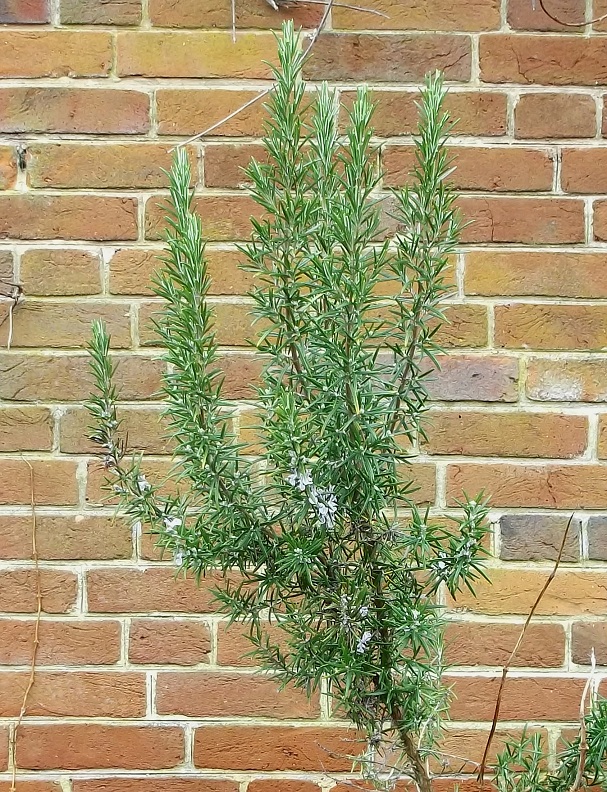
Rosemary (Rosmarinis Officinalus) and Gilded Rosemary (Rosmarinis Offcinalus 'Veregatus'). 

Rosemary is for remembrance
Between us day and night,
Wishing that I may always have
You present in my sight.

Traditional Greek Ballad

Caption at Castle Bromwich Hall Gardens.
Rosemary is native to the Mediterranean. Found growing wild along cliffs, near the sea – it is an evergreen shrubby herb with pungently aromatic leaves. John Evelyn the 17th century garden writer reported that the perfume was so strong that it could be detected 30 leagues off the coast of Spain.

Legend has it that the Virgin Mary spread her cloak over a rosemary bush while she rested, and as a result of this the flowers turned blue like her cloak. From then on, the bush was called ‘Rose of Mary.” 

Rosemary is also known as ‘Sea rose, Herb of Crowns, Mary’s Tree, Guardrobe, Incensier, Elf Leaf, Sea Dew, Dew of the Sea, Polar Plant, Mary’s Cloak, Libanotis, Stella Maria, Star of The Sea, Compass Weed and Compass Plant’

The word ‘Rosmarinus’ comes from the Latin word ‘rosmaris’ which means ‘dew of the sea’, which is a reference to rosemary’s refreshing effects on the spirit and the fact that rosemary’s habitat in the Mediterranean is usually along the coastal regions. 

Rosmarinus officinalis – Kohler Medizinal-Pflanzen – 1897 - Public Domain
The ancients knew well of rosemary’s refreshing effects- ancient Greek students would wear garlands of rosemary to increase their memory and this is how rosemary became to be called the ‘Herb of Crowns.’ 

Rosemary has long been recognised as a symbol of remembrance, and an example of its symbolic use today is seen at funerals where guests wear a sprig of rosemary and a sprig of rosemary is also cast onto the coffin of the deceased. 

Rosemary (Rosmarinus Officinalis)
The ancients also used rosemary as a respiratory ailment treatment and as sacred incense in some religious ceremonies. Sprigs of rosemary have been found in Egyptian Tombs (3000 BC.) It was the Arabs who first extracted the essential oil of Rosemary. The Romans used rosemary to decorate statues of their household Gods as rosemary symbolised stability. 

The plant produces masses of powder blue flowers from early spring to early summer, which are attractive to beneficial pollinators such as bees – which is useful in a Kitchen Garden containing trained fruit (espaliers, cordons and fans. The leaves on the Gilded Rosemary variety, as the name suggests, has a yellow gold-colour shot through the leaves.

Rosemary (Rosmarinus Officinalis)

Gilded Rosemary (Rosmarinus Offcinalis 'Veregatus')
Rosemary prefers a light soil. A sandy soil will fully satisfy its meagre feeding needs. Rosemary is actually tolerant of most soil conditions as long as they are not water-logged. 

Rosemary also prefers a slightly limey soil (the opposite of acid) because this results in smaller plants with more fragrant leaves. True to its origins, rosemary will grow well in sunny and sheltered conditions. It will even stand severe frosts if conditions are not windy and wet as well.

The ideal time to plant out rosemary is April. Dig a hole in the soil slightly larger than the size as the pot. Add 1cm (half an inch) of sandy soil or sharp sand to the bottom of the hole. Place the plant in the hole and fill around with a mix of half sharp sand and half from the removed soil.

Rosemary does not like to have its roots disturbed, so leave as much of the root ball undisturbed as possible. Water well if the conditions are at all dry.

Rosemary requires very little care throughout the year. Water only when the compost is clearly dried out and feed once a month with liquid fertiliser from April to October. Trim the side stems to keep the plant to the size you want, the best time to do this is just after they have flowered. Cut back frost-damaged plants to healthy wood; straggley, old plants can be cut back hard at the same time. If the puning is neglected, hard wood will form from which new growth is impossible to emerge.


Rosemary (Rosmarinus Officinalis) with hard wood accumulation


Seeds are readily available from most major seed merchants. The seeds are cheap, although propagation is erratic. Sow the seeds in potting compost around mid-May time and place in a sheltered position in the garden  - be aware that you may only achieve a  success rate of about 15%. The seedlings may well take up to 2 months to appear so don't give up hope until around 3 months have passed.

The best method of propagating Rosemary is by taking cuttings, mid-May or June being the best time.Select a healthy looking plant with lots of new growth on it. Use a sharp knife to take 7.5cm (3in) cutting from young shoots either just below a leaf joint or torn off at the stem. If tearing off a cutting, trim the "heel" to remove most, but not all of it. Strip of the leaves from the lower 4cm (1½in), pulling them off with your fingers. Fill a 7.5cm (3in) pot with standard potting compost and insert one or two cuttings in each pot. Water the compost from below and place in a propagator or cover it with a plastic bag. A temperature of 15°C to 20°C (60°F to 70°F) is needed for the cuttings to root. A windowsill out of direct sunlight is an ideal position. They can be transplanted to their permanent position when they have rooted, which will be in roughly 8 weeks.

Rosemary grows extremely well in large pots or other containers. The pots need to be reasonably deep because rosemary is a deep rooting herb. Fill the pot with a mixture of 20% sharp sand or grit and 80% standard potting compost. Make a hole in the compost and place one rooted cutting in the middle of the pot. Water the plant well to help it settle in and consolidate the soil around the roots. Container grown plants are more likely to affected by severe frosts, so move the containers close to the house walls in winter.

Gilded Rosemary (Rosmarinus Offcinalis 'Veregatus')

Pliny (23 - 79 AD), Dioscorides (contemporary of Pliny and author of De Materia Medica a work on the use and identification of medical herbs which was the basis of medical practice for the next 1400 years), and Galin all wrote of rosemary. It was cultivated by the Spanish in the 13th century and was a popular condiment with salt meats from the 15th to 18th centuries.

Rosemary was often entwined into a wreath, dipped in scented water and worn by brides at the alter. The wreath symbolized fidelity, love, abiding friendship and remembrance of the life the woman had led prior to her marriage.


The crowns and garlands of rosemary at weddings led to the lays, or amorous ballads of the Troubadours (approx. 1100 - 1350) referring to rosemary as "Coronaria".


Anne of Cleves (1515 - 1557), Henry the Eighth's 4th wife, wore a rosemary wreath at their wedding. At that time, wealthy bridal couples would also present a gilded branch of rosemary to each wedding guest.

Newly wed couples would also plant a branch of rosemary on their wedding day. If the branch grew it was a good omen for the union and family. In ‘A Modern Herbal’, Mrs Grieves says “A rosemary branch, richly gilded and tied with silken ribands of all colours, was also presented to wedding guests, as a symbol of love and loyalty.” Another example of rosemary’s use as a love charm was that a young person would tap another with a rosemary sprig and if the sprig contained an open flower, it was said that the couple would fall in love. Rosemary was used as a divinatory herb-several types of herbs were grown in pots and assigned the name of a potential lover. Then they were left to grow and the plant that grew the strongest and fastest gave the answer. Rosemary was also stuffed into poppets (cloth dolls) in order to attract a lover or attract curative vibrations for illness. It was believed that placing a sprig of rosemary under a pillow before sleep would repel nightmares, and if placed outside the home it would repel witches. 

Rosemary (Rosmarinus Officinalis)
Robert Hacket, in a wedding sermon in 1607 said, "Let this Rosemarinus, this flower of men, ensigne of your wisdom, love and loyaltie, be carried not only in your hands, but in your heads and hearts." Herrick talks of rosemary's attachment to both beginning and end of adult life with:

"Grow for two ends - it matters not at all
Be't for my bridall, or my buriall."
 
In the 14th Century, rosemary root was "seethed in wine vinegar" and the lotion was then used to wash the feet of a thief. The lotion was thought to sap the strength of the robber so that he would not longer commit robbery, steal or do any further harm. In a humorous aside, our original source for this bit of folklore questions their own source with, "How the potential or suspected thief is to be persuaded to wash his feet, the manuscript does not divulge."
The Countess of Hainault, Jeanne of Valois (1294 - 1342), sent her daughter Queen Phillippa (1311 - 1369), wife of King Edward III of England (1312 - 1377), an accounting of the virtues of rosemary and it is presumed a number of plants or cuttings accompanied the gift. The original manuscript can be found in the British Museum. The Countess suggests that laying the leaves under the head of a man while he sleeps will "doth away evell sprirites and suffereth not the dreeme fowl dremes ne to be afearde."

Bancke, in his work Herball from 1525, suggests techniques to use rosemary as a remedy for both gout of the legs and to keep the teeth from all evils. He also recommended that smelling rosemary regularly would "keep thee youngly."


Gerard, author of Herball or Historie of Plants(1597), referred to someone named Serapio who suggested that a garland of rosemary worn about the head was a remedy for the "stuffing of the head, that commeth through coldnes of the brain." He also mentions that rosemary grew so plentifully in Languedoc (a former province in south-eastern France) that "the inhabitants burne scarce anie other fuel."

Gilded Rosemary (Rosmarinus Offcinalis 'Veregatus')

Rosemary was also believed to offer protection from the plague. In 1603, when bubonic plague killed 38,000 Londoners, the demand was so high that the price increased from one shilling for an armful to six shillings for a handful. To put that price increase in perspective, one pricelist from 1625 indicated that one could obtain 18 gallons of good ale or double beer with carriage(delivery?) for only 3 shillings or an entire 'fat pig' for 1 shilling.

Richard Folkard, author of Plant Lore, Legends and Lyrics, written in 1892, mentions that in Sicily, rosemary was a favored plant and that "the young fairies, under the guise of snakes, lie concealed under its branches." 


Rosemary and thyme were used on St. Agnes' Eve, an evening and day that honors St. Agnes, the patron saint of virgins and young girls. St. Agnes' eve is celebrated on January 20th and 21st. Wikipedia mentions some rituals practiced on St. Agnes' Eve were to aid young girls in discovering their future husbands, a superstition that was the main theme of John Keat's poem, The Eve of Saint Agnes


A common saying of rosemary was, "Where rosemary flourishes the lady rules." According to the same folklore, a man seeking relief of his lady's rule would find no benefit from damaging or destroying a vigorous bush of rosemary.


Rosemary (Rosmarinus Officinalis)
Parkinson (1567-1650), the King's Botanist to Charles I, mentions that in countries where rosemary is well-suited and grows to a large size that thin boards of rosemary were used to make lutes and other instruments, carpenters rules, and a myriad of other implements. The French believed that combing their hair once a day with a rosemary wood comb would prevent giddiness. Uncrupulous merchants however, would often use other woods and simply scent them with rosemary oil.


Shakespeare's (1564 - 1616) Ophelia says in Hamlet, "There's rosemary, that's for remembrance. Pray you, love, remember!" He also mentions how the English once placed rosemary in coffins and around graves in Romeo and Juliet when Father Lawrence says:
"Dry up your tears, and stick your Rosemary
On this fair corse."
There was a bit of disagreement within our sources as to the reason rosemary was often placed with corpses at burial. Most linked its usage to being a plant associated with remembrance. One source, Herbal Simples Approved for Modern Uses of Cure, believed the custom stemmed from a much more practical application. It was thought that the smelling of rosemary provided a powerful "defence against any morbid effluvia from the corpse." In other words, rosemary was used by mourners to provide relief from the odor of decomposition.


With perhaps some reference to fidelity and his lack thereof, a soldier shot in 1649 for mutiny was buried with rosemary. His body was adorned with branches of rosemary but half of each branch had been stained with blood.


Queen Elizabeth was fond of mead and her own recipe for the drink included the leaves of sweet briar, with rosemary, cloves and mace. (Unfortunately, our source failed to identify which Queen Elizabethe they were talking about.)


French hospitals, at one time, burned Juniper berries with rosemary to correct vitiated or poor quality air and to prevent infection. Additionally, in the French language of flowers, rosemary represents the power of rekindling lost energy.


Rosemary was once used to create Essence of Mustard which also included spirits of turpentine and black mustard seed. The resulting oil was not prone to going rancid and was used by clockmakers and for other "instruments of precision."


In Spain, rosemary was used as a protection against witchcraft and menaces on the road. George Borrow mentioned how he came to learn about this superstition in his work The Bible in Spain (1843). He first mentions meeting a traveler who had adorned his hat with rosemary and later mentions a lady, who concerned for Borrow's own safety, offered him some for his own hat. Despite the promised protection provided by the Rosemary, Borrow met with a series of misfortunes on his journey. He contemplates a return visit to the lady to inform her of the failure of the protective abilities of rosemary.


An old Spanish proverb says of rosemary that men who are indifferent to the scent of rosemary are likely to be insensitive about other pleasures:
...Who passeth by the rosemarie
And careth not to take a spraye
For woman's love no care has he,
Nor shall he though he live for aye...
In 1235, The Queen of Hungary became paralysed and legend has it that a hermit soaked a pound of rosemary in a gallon of wine for several days and then rubbed it on her limbs. This treatment cured the Queen Elizabeth of Hungary of her paralysis, and the rosemary-wine combination became known as ‘Queen of Hungary’s Water.’ This concoction was used for centuries to treat dandruff, gout, skin problems and to prevent baldness.


Rosemary (Rosmarinus Officinalis) - Unknown Italian Artist - circa. 1500 - Public Domain
The French hung rosemary in hospitals and sickrooms as healing incense. It was referred to as ‘incensier. Rosemary was the favourite scent of Napoleon Bonaparte. 
  
How to make Rosemary Sugar:


Clean and dry well several sprigs of fresh rosemary. Place in a canister or srew-topped jar and cover with 1 lb of sugar. Shake well and leave to stand for 24 hrs. Shake well again and leave to stand for several days. Remove the sprigs of rosemary and the sugar is ready for use in milk puddings, egg custards etc. 

Gilded Rosemary can be found at Castle Bromwich Hall Gardens in the edge-beds alongside the Batty Langley Kitchen Garden.

 
Rosemary (Rosmanus Officinalus) can be found at very points in the Gardens, so have fun looking for it!

This article has been fabricated from several sources to who grateful thanks are due:


Thanks are also due to:

  • Gordon Sammons
  • Chris Hitchcock
  • Brian Jennings

All photographs (unless credited elsewhere) are by Yvonne High, and are licensed under a Creative Commons Attribution-NonCommercial 2.0 UK: England & Wales License