07/07/2012

Plant of the Month - July 2012

 Tulip Tree ( Liriodendron tulipifera)

O Tulip Tree, O Tulip Tree
What changes time hath wrought!
What scenes have passed beneath thy bough,
That fleeting age hath brought.
 
Tulip Tree Poem - Augustus Post, 1933.


A tall, stately tree with uniquely-shaped leaves four lobed with a flattened tip. These large leaves flutter in the breeze and at the end of the season turn bright gold. The tulip like flowers do not begin to appear for about 25 years, and are never really conspicuous. 


Liriodendron tulipifera — known as the tulip tree, American tulip tree, tuliptree, tulip poplar and yellow poplar — is the Western Hemisphere representative of the two-species genus Liriodendron, and the tallest eastern hardwood. It is native to eastern North America from Southern Ontario and Illinois eastward across southern New England and south to central Florida and Louisiana. It can grow to more than 50 m (165 feet) in virgin cove forests of the Appalachian Mountains, often with no limbs until it reaches 25–30 m (80–100 feet) in height, making it a very valuable timber tree. 

It is fast-growing, without the common problems of weak wood strength and short lifespan often seen in fast-growing species. The flowers are pale green or yellow (rarely white), with an orange band on the tepals; they yield large quantities of nectar. The tulip tree is the state tree of Indiana, Kentucky, and Tennessee. 


"Tulip tree" is certainly a misleading name for a tree that is actually a member of the magnolia family. Nevertheless, that is the name by which this handsome tree is called worldwide, due to its colorful, tuliplike orange and yellow flowers. Although no 200-foot tulip trees are known to exist today, some reports say that they did once upon a time. 


The Tulip Tree can be found in the Lower Wildeness of Castle Bromwich Hall Gardens.


How to Grow

Growing Tulip tree seedlings at home is fairly easy: Young trees can be purchased from the local nursery or garden centre. To grow your own seedlings, seeds can be gathered from mature trees, which develop seed bearing fruit during the fall season. Simply allow the seed pods to dry on the tree, then break them open to harvest the seeds inside. Of course, seeds can be purchased also, from any number of commercial sources.

Sowing Tulip trees outdoors should be done in the Autumn, either directly in the ground or in buried pots. Fall planting allows the seeds to have a period of cold dormancy over the winter that prepares them for spring germination. Soil should be loose and well drained to avoid soggy conditions that could rot the seeds or cause them to mould. If planting in containers, be sure there are large drainage holes in the bottom to prevent them from flooding during rainy conditions or when snow melts in the spring.

Starting seeds indoors is best done in the late winter or early spring. Seeds kept over the winter should be placed in a plastic bag or container, either wrapped in moist paper towelling or submerged in moist peat moss, and refrigerated to simulate the natural period of cold they would experience if planted outdoors.

Planting is best done in a sunny location, although tulip trees will tolerate light shade. Rich, well drained loam is the ideal soil for planting, but tulip trees are fairly adaptable, often thriving in less than ideal conditions. Whether transplanting purchased seedlings or ones started at home, be sure that soil is loosened well around the area for easy root growth, enhanced with a bit of compost.

Place the young tree in a planting hole that is three times the width of its root-ball, and backfill the hole, being sure to tap the soil gently around the roots to avoid leaving air pockets.

Keep the soil moist around your young Tulip trees during the first few seasons of growth, but be sure to avoid over watering, as soil that is too wet can be worse than overly dry conditions for your seedlings. Adding some support is a good measure to take, either staking or caging new trees until strong roots develop. Mulching often helps young tulip trees grow more quickly, helping to maintain moisture in the soil and discourage weeds that would otherwise compete for soil nutrients.


Pruning of this lovely tree is not usually necessary. If you wish to do any propagation from this tree, you may do so by layering shoots in spring- wait two years before severing from the parent plant.

History

Because of its great beauty and size, the tulip tree has a valued place in American history, as well as an honoured one in the gardens of Europe. This tree’s many folk and informal names attest to its popularity and extensive range. To many in the lumber industry it is known as the yellow-poplar. 

In Tennessee it is sometimes called canoe wood because Native Americans and early settlers carved canoes from its light, buoyant trunks. No less of a woodsman than Daniel Boone chose such a canoe to carry his own family from Kentucky to the western frontier. Tuliptree also had a wide range of medicinal uses, with many teas, ointments, and solutions being made from it. George Washington admired this tree as well, with a giant he planted in 1785 being selected as Mount Vernon’s official Bicentennial Tree. 
 
The flowers are very popular with honey bees, since a single tulip poplar flower has enough nectar to fill a bee’s honey stomach.  (Most other types of flowers require a honey bee to visit as many as 100 blooms to fill her stomach with nectar.) 

The honey produced from the flowers is a dark honey, amber in colour with a rich, complex flavor.  Honey has lots of health benefits, and research suggests that dark honey like tulip poplar is particularly high in antioxidants.

Be sure to find this lovely plant next time you visit the Gardens!


Thanks to:

http://viewfromthehive.wordpress.com
Wikipedia
Wikimedia Commons
ehow.com
Gordon Sammons 

All pictures are Public Domain.


02/06/2012

Plant of the Month - June 2012

Laburnum anagyroides 

Mark yonder, 
how the long laburnum drips 
Its jocund spilth of fire, its honey of wild flame!

 —Francis Thompson, Sister Songs (1895) 


 Laburnum Anagyroides - Public Domain

Laburnum anagyroides (Common Laburnum, Golden Chain or Golden Rain) is a species of small deciduous trees or large shrubs up to 7 m tall in the genus Laburnum, native to Central and Southern Europe. It is a popular ornamental plant, along with the other species in the genus, L. alpinum, and especially the hybrid between them, L. × watereri. L. anagyroides blooms in late spring with pea-like, yellow flowers densely packed in pendulous racemes 10-20 cm (4-8 in) long. 

The yellow flowers are responsible for the old poetic name 'golden chain tree' (also spelled golden chaintree or goldenchain tree). The plants can be found in the Upper Wilderness of the gardens, and as usual are stunning examples. 


Most garden specimens are of the hybrid between the two species, Laburnum × watereri (Voss's laburnum), which combines the longer racemes of L. alpinum with the denser flowers of L. anagyroides; it also has the benefit of low seed production. The Laburnum plant will poison anyone who consumes the seeds for mistaking them for peas. Consequently this beautiful brightly coloured plant has a somewhat dark reputation. 

All parts of the plant contain Cytisine. Cytisine was discovered in 1863 by Husemann and Marme. It is a white, crystalline solid, of a bitter, somewhat caustic taste, with a very poisonous action. All parts of the laburnum plant are poisonous, and can be lethal if consumed in excess. Symptoms of laburnum poisoning may include intense sleepiness, vomiting, convulsive movements, coma, slight frothing at the mouth and unequally dilated pupils. In some cases, diarrhea is very severe, and at times the convulsions are markedly tetanic. 

As with most other plants of this type though if sensible precautions are observed (don’t eat it, keep children away from it, wash hands after handling etc.) risks are minimised. Cytisine is also an ingredient in some insecticides. Detail of the flowers A shrub with smooth bark, dark green spreading branches and pendulous and pubescent twigs. The leaves (made of three leaflets) have a long pedunculus, are smooth on the upperside and hairy on the underside. The flowers are golden yellow and sweet scented, are grouped in pendulous racemes up to 25 cm long, and typically bloom in May. 

The seeds are legumes with large numbers of black seeds that contain cytisine, which is an alkaloid poisonous not only to humans but also to goats and horses, especially when not ripe. However, some wild animals such as hares and deer can feed on them without any ill-effects, and because of this the plant is believed to have magic properties in some regions. 

Growth 

Laburnum trees are not too fussy as to which type of soil they live in, as they can thrive in well drained light soil, heavy clay soil, acidic soil or a chalky alkaline soil. Make sure that your plant is situated in full sun, as laburnums are sun worshippers. The best time to plant laburnum seeds is from September to November. The best time to take a laburnum cutting is from December to February. As long as you plant your laburnum tree in full sun, then there shouldn't really be much to do thereafter. 

Laburnums are notorious for being short-lived, but they offer copious amounts of seeds every year, so they tend to regenerate themselves. Many gardeners try to remove the drying seed pods from laburnum trees as this encourages a good show of flowers the following year. Uses Despite its poisonous nature, Laburnum wood does have some use. The heart-wood of the Laburnum was often used as an Ebony substitute as it is very hard and coloured a dark chocolate brown. The sapwood surrounding the heart-wood is in contrast a bright yellow. The wood has been used for making the handles of tools and for use in various crafts. It is also ideal for making posts, for woodturning and as fuel. 

In the past (and today on historic re-enactments) it was used for making bows. Laburnum has historically been used for cabinetmaking and inlay, as well as for musical instruments. In addition to such wind instruments as recorders and flutes, it was a popular wood for Great Highland bagpipes before taste turned to imported dense tropical hardwoods such as cocuswood, ebony, and African blackwood.

Folklore

I’m afraid quaint folklore tales regarding the Laburnum are rather thin on the ground, generally focusing on the ‘unlucky’ side of things (which considering the toxic properties of the plant is hardly surprising) and making very boring reading, truth be told. 

Laburnums have a much more colourful CV in fiction however; In the TV mystery series Mother Love, Helena (Diana Rigg) muses over what plant she should use to poison a pair of children and chooses the laburnum, saying, "Laburnum! Such a pretty tree – and so many of them!" 

In the Doctor Who serial The Mark of the Rani, the Sixth Doctor suggests that if the Master turned into a tree, it would be a laburnum, because they have poisonous pods. 

The novel A Melon for Ecstasy by John Fortune and John Wells is, in part, about the main character's forbidden love affair with the laburnum in his back yard. Laburnum seeds are the agent of suspected poisoning in the Daphne du Maurier novel My Cousin Rachel

In Wizardborn, the third book in Dave Wolverton's (David Farland) The Runelords series, Averan, the Earth Warden, chooses her staff of power from the wood of the laburnum tree. It has also been stated that The writer J. R. R. Tolkien was inspired by the laburnum for his creation of Laurelin, one of the two mythological trees in The Silmarillion, and Tolkien's description of it is strongly influenced by Thompson's verses. 

So that’s the laburnum. Enjoy, but handle with care! Check out this beautiful plant at your next visit. 

Thank you: 

Gordon Sammons


Creative Commons Licence
The photographs taken by Graham High in this work are licensed under a Creative Commons Attribution-NonCommercial 2.0 UK: England & Wales License.

06/05/2012

Plant of the Month - May 2012.

Syringa vulgaris (Common Lilac)

Click on pictures to view them full size


In the dooryard fronting an old farm-house near the white-washed palings,
Stands the lilac-bush tall-growing with heart-shaped leaves of rich green,
With many a pointed blossom rising delicate, with the perfume strong I love,
With every leaf a miracle -and from this bush in the dooryard,
With delicate-coloured blossoms and heart-shaped leaves of rich green,
A sprig with its flower I break.

When Lilacs in the Dooryard Bloomed (Third Verse) by Walt Whitman 

Our plant of the month for May 2012 is Syringa vulgaris, otherwise known as the Common Lilac. It is a member of the Olive family (Oleaceae).


Common Lilac. "Published by W. Curtis St. George: Crescent Feb. 1. 1792". Published in Curtis Botanical Magazine. 
The name of this genus is from the same root as syringe, derived from the Greek word for “pipe.” This name was first given to the mock orange, of the genus Philadelphus from the Saxifrage family. Its stems were frequently used to make pipes of the musical, rather than smoking, variety. To add to the taxonomical confusion, the mock orange today in some parts of the world is known by the common name, “Syringa.”
Enough of this. The true Syringa is the Lilac. In case you’ve ever wondered which came first, the naming of the colour or of the plant, we can at least solve that mystery: the plant acquired the common name, lilac, because of its purple flowers. Lilac can be traced to the Sanskrit word for purple. The sweet scent is one of the most familiar in any garden. 

A lilac bush (Syringa vulgaris) showing a panicle with multiple flowers in bloom and leaves. Taken by John O'Neill, 2007. Licensed under the Creative Commons Attribution-Share Alike 3.0 Unported licence.


This shrub is 8-20 inches tall, and sends up multiple branching stems that form a vase-shaped crown. Stems at the base of this shrub are up to 8 inches across. The bark of large old stems is gray to gray-brown, somewhat rough-textured, slightly shredded, and sometimes shallowly furrowed. The bark of young stems is gray to brown and smooth, while new shoots are green and glabrous. Pairs of opposite leaves occur along the young stems and shoots.

Individual leaves are 2-5" long and 1½-3½" across. The upper leaf surface is yellowish green to dark green and hairless, while the lower surface is pale green and hairless.

Syringa vulgaris can be located in various beds in the Upper Wilderness, and is unmissable.


Brief History:
Both Syringa vulgaris and the finer, smaller "Persian Lilac" (now considered a natural hybrid) were introduced into European gardens at the end of the sixteenth century, from Ottoman gardens. The Holy Roman Emperor's ambassador, Ogier Ghiselin de Busbecq, is generally credited with supplying lilac slips to Carolus Clusius, about 1562.
Well-connected botanists, like the great herbalist John Gerard, soon had this rarity in their gardens: Gerard notes that he had lilacs growing “in very great plenty” in 1597, but John Loudon was of the opinion that the Persian lilac had been introduced into English gardens by John Tradescant the elder.
In the American colonies lilacs were introduced in the eighteenth century. Peter Collinson, F.R.S., wrote to the Pennsylvania gardener and botanist John Bartram, proposing to send him some, and remarked that John Custis of Virginia had a fine "collection", which Ann Leighton interpreted as signifying Common and Persian Lilacs, in both purple and white, "the entire range of lilacs possible" at the time.
Common lilac tends to flower profusely in alternate years, a habit that can be improved by deadheading the flower clusters after the colour has faded and before seeds, few of which are fertile, form. At the same time twiggy growth on shoots that have flowered more than once or twice can be cut to a strong, outward-growing side shoot.

Care:
Young lilacs tend to flower sparingly and variously until they are established. Lilacs enjoy full sunshine, an opportunity to spread its branches and still have plenty of air circulation, and a well-drained soil that is not acidic.
Lilacs appreciate an alkaline soil; and many sources recommend adding lime out to the drip line in the fall. Feed your lilac twice a year, once in late winter or very early spring, and again after bloom.
In late summer, lilacs can be attacked by powdery mildew, specifically Erysiphe syringae, one of the Erysiphaceae.
Pinch back your young lilac to establish its shape, and remove old blossoms as promptly as you can. Remember that next year’s flower buds form in pairs where the leaves join the stems; severe pruning will mean fewer blossoms in the following year. As with other flowering shrubs, pruning is best done right after flowering, to preserve as many of next year’s flowers as possible. If you need to completely renovate an older lilac, do the severe cutting back during the winter, while the plant is fully dormant. Suckers are often a problem, particularly if you’ve purchased a lilac that’s grafted onto root stock. They are tough plants and they will provide you with beauty most every spring for many years, in return for regular, routine care. 
Medicinal Action and Uses:

(Castle Bromwich Hall Gardens Trust cannot take any responsibility for any adverse effects from the use of plants. Always seek advice from a professional before using a plant medicinally).

Lilics were used as a vermifuge (a drug or other substance that causes worms or other parasites to be expelled from the intestines) in America, and as a tonic, an anti-periodic (a remedy used to prevent the recurrence of certain illnesses) and as a febrifuge (a drug that reduces fever). Lilacs may also be used as a substitute for aloes and in the treatment of malaria.

Superstitions and stuff...

A Old English superstition is that Lilacs are harbingers of death, doom, and / or misfortune, so therefore should not be brought indoors. The origin of this superstition is unknown, although there are plenty of websites our there willing to take a crack at an explanation, usually with contradictory results.

Fans of the Adam West / Burt Ward ‘Batman’ series will no doubt be disappointed to learn that there is no such variety as the man-eating lilac (as employed by super-villain ‘Louis the Lilac’) outside the magic of television. There is also no evidence that consuming ‘sweet and heady’ Lilac Wine (as in the James Shelton song covered by Elkie Brooks, Jeff Buckley, and others) will bring back any lost lovers whatsoever.

The Lilacs at the gardens are at their best right now, so drop in soon and visit them!
Thank you:


Creative Commons Licence
The photographs taken by Graham and Christopher High in this work are licensed under a Creative Commons Attribution-NonCommercial 2.0 UK: England & Wales License.

07/04/2012

Plant of the Month - April 2012

Awake, thou wintry earth
Fling off thy sadness! 
Fair vernal flowers, 
laugh forth Your ancient gladness! 

Thomas Blackburn, "An Easter Hymn" 

Spring is not the best of seasons. 
Cold and flu are two good reasons; 
wind and rain and other sorrow, 
warm today and cold tomorrow. 
 Author Unknown 

Yes, Spring has arrived in its full unpredicatable glory at the Gardens, and we have tried to be equally unpredictable with our choice of plant of the month: 

Amelanchier canadensis 

(Snowy Mesipulus, aka Shadbush, aka Canadian serviceberry, aka chuckleberry, aka currant-tree, aka Juneberry, aka Shadblow Serviceberry, aka Shadblow, aka Shadbush Serviceberry, aka Sugarplum, aka Thicket Serviceberry). 


Rasbak 2005 - Wikimedia Commons 

This beautiful architectural plant with such a variety of names is of extended interest throughout most of the year. It gives an handsome display of mass white star-shaped blossom in April, and has gorgeous medium green foliage. After flowering lovely berries appear in July and the tree itself has stunning red/bronze bark. The flowers are hermaphrodite (have both male and female organs) and are pollinated by Bees.The plant is self-fertile. 

Amelanchier canadensis is a deciduous Shrub growing to 6 m (19ft) by 3 m (9ft) at a medium rate. It is hardy tree (not frost tender). The tree requires very little pruning. It prefers light (sandy), medium (loamy) and heavy (clay) soils and can grow in heavy clay soil.The plant prefers acid and neutral soils. It can grow in semi-shade (light woodland) or no shade.It requires moist soil, but it dought hardy. The plant can tolerate strong winds but not maritime exposure. 

Prized for their profuse flowers and foliage colour as much as their fruit, dozens of species of Amelanchier (Family Rosaceae, subfamily Pomoideae) are cultivated mostly as home garden plants in North America. Various species are adapted to every state in the US and province of Canada, but most fruit production occurs in northern areas - Michigan, Minnesota, Canada. Common names include: juneberry, serviceberry, sarvis or sarvistree, shadblow, swamp sugar pear, currant tree, snowy mespilus, indian pear, Saskatoon berry, Canadian medlar, bilberry, maycherry. The name "saskatoon" derives from the Blackfoot Indian word "mis-sask-quah-too-min". 

The fruit is edible - raw or cooked. The fruit contains a few small seeds at the centre, it has a sweet flavour with a hint of apple. It can be eaten out of hand, used in pies, preserves etc or dried and used like raisins. The opinions of consumers is that the fruit can be of variable quality, with some forms having a distinct bitterness in the flavour whilst others are sweet, juicy and delicious. When the fruit is thoroughly cooked in puddings or pies the seed imparts an almond flavour to the food. The fruit is rich in iron and copper, and is about 10mm in diameter. Trees can yield 7 to 15 tonnes per hectare. 

Fully matured Juneberries are most often processed into wine, whilst fruit harvested early is best for processing, and fully mature fruit are best for fresh consumption or wine. The plains indians used Amelanchier berries to make pemmican, a staple food consisting of dried lean meat, fat, and dried berries. Pemmican is a form of exotic 'five-spice' flavouring, which probably accounts for why it was originally planted at Castle Bromwich Hall Gardens. 

The plant itself can be located in the Upper Wilderness:


and the following pictures pay testament to the plants beauty (click on the picture for the full size image): 


Medicial Uses: 

(Castle Bromwich Hall Gardens Trust cannot take any responsibility for any adverse effects from the use of plants. Always seek advice from a professional before using a plant medicinally). 

A crude extract of berries is currently being investigated as an agent for cancer treatment. 

A tea made from the root bark (mixed with other unspecified herbs) was used as a tonic in the treatment of excessive menstrual bleeding and also to treat diarrhoea, a bath of the bark tea was used on children with worms, an infusion of the root was used to prevent miscarriage after an injury, and a compound concoction of the inner bark was used as a disinfectant wash. 

Propagation: 

From Seed - it is best harvested 'green', when the seed is fully formed but before the seed coat has hardened, and then sown immediately in pots outdoors or in a cold frame. If stored seed is obtained early enough in the autumn, it can be given 4 weeks warm stratification before being left out in the winter and it should then germinate in the spring. Otherwise seed can be very slow to germinate, perhaps taking 18 months or more. When large enough to handle, prick the seedlings out into individual pots and grow them on in a sheltered outdoor position, planting them out once they are 20cm or more tall. If there is sufficient seed it is best to sow it thinly in an outdoor seedbed. 

Grow the seedlings on for two years in the seedbed before planting them out into their permanent positions during the winter. Layering in spring - takes 18 months. Division of suckers in late winter. The suckers need to have been growing for 2 years before you dig them up, otherwise they will not have formed roots. They can be planted out straight into their permanent positions if required. 

So there you have it, Amelanchier canadensis. Lots of crazy names, one lovely shrub. Please come and check it out when you next visit our gardens! 

Further Reading: 

F. Chittendon. RHS Dictionary of Plants plus Supplement. 1956 
Comprehensive listing of species and how to grow them. Somewhat outdated, it has been replaces in 1992 by a new dictionary. 

Hedrick. U. P. Sturtevant's Edible Plants of the World. Simmons. 

A. E. Growing Unusual Fruit. A very readable book with information on about 100 species that can be grown in Britain (some in greenhouses) and details on how to grow and use them. 

Bean. W. Trees and Shrubs Hardy in Great Britain. Vol 1 - 4 and Supplement. A classic with a wealth of information on the plants, but poor on pictures. 

Clapham, Tootin and Warburg. Flora of the British Isles. A very comprehensive flora, the standard reference book but it has no pictures. 

Fernald. M. L. Gray's Manual of Botany. A bit dated but good and concise flora of the eastern part of N. America. 

Uphof. J. C. Th. Dictionary of Economic Plants. An excellent and very comprehensive guide but it only gives very short descriptions of the uses without any details of how to utilize the plants. Not for the casual reader. 

Turner. N. J. and Szczawinski. A. Edible Wild Fruits and Nuts of Canada. A very readable guide to some wild foods of Canada. 

Huxley. A. The New RHS Dictionary of Gardening. 1992. Excellent and very comprehensive, though it contains a number of silly mistakes. 

Thanks to: 

Gordon Sammons 

All photographs by Graham and Christopher High 2012 unless otherwise credited.

02/03/2012

Plant of the Month - March 2012

Cyclamen

This fragrant plant from sunny Italy,
Plucked by our passing hand, was homeward brought:
Memorial of that favoured clime to be,
And minister sweet food to retrospective thought.

Unchecked in growth, it well repays our care,
Gladdening our cottage with its constant bloom:
By nature prompted, half the varied year;
The other,--gay in honour of its new--found home.

On a Cyclamen – Henry Alford (1810 – 1871)

The Cyclamen is a genus of 23 species of perennials growing from tubers, valued for their flowers with up-swept petals and variably patterned leaves. Cyclamen species are native from Europe and the Mediterranean region east to Iran, with one species in Somalia.

The fresh and delicate beauty of Cyclamen flowers were beloved by illustrators of the past, both for horticultural identification,


Cyclamen purpurascens - Original book source: Prof. Dr. Otto Wilhelm Thomé Flora von Deutschland, Österreich und der Schweiz 1885, Gera, Germany. Permission granted to use under GFDL by Kurt Stueber.

and for attractive greetings cards.


Vintage birthday postcard with country scene surrounded by pink Cyclamen flowers, by John Winsch 1910


The species of Cyclamen of most interest to Castle Bromwich Hall Garden fans is Cyclamen coum. 

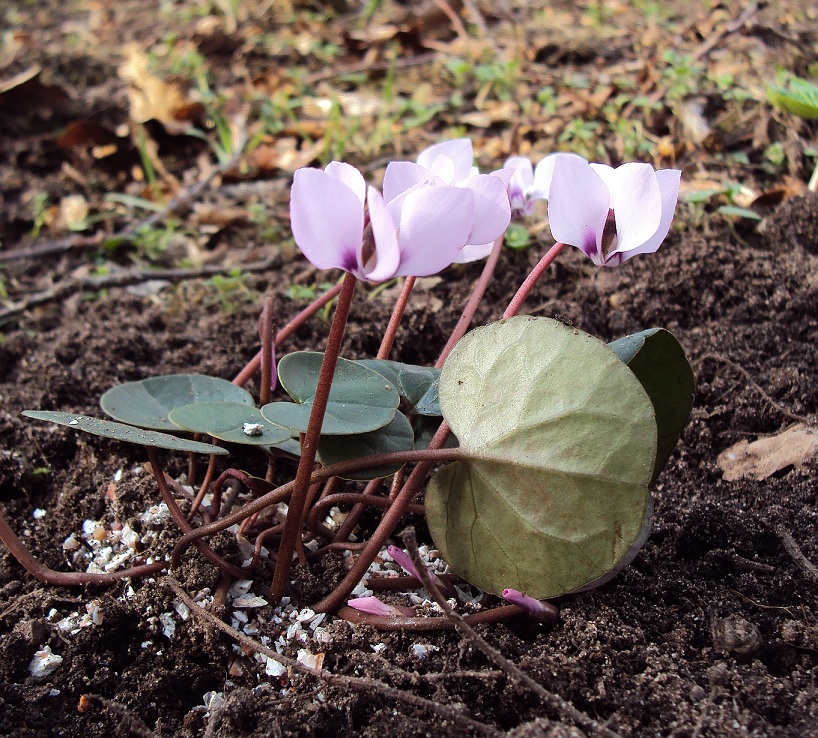
Cyclamen coum is a beautiful hardy perennial, that produces lovely dainty flowers from late winter to early spring. The leaves have silver marks around the edges and are over the beautiful dark green leaves. Coum loves both shade and partial shade, is not fussy with soil type, this can vary from light well drained soil to heavy clay soil. Likes acid or alkaline soil.

Cyclamen coum is one of a group of cyclamens (Cyclamen sub genus Gyrophoebe series Pubipedia) with stubby flowers and nearly round leaves. Species of the group are native to areas near the coasts of the eastern Mediterranean and the Black and Caspian Seas, from sea level to alpine tundra.

The tuber produces roots from the center of the bottom only.[2] It remains small, only reaching about 6.5 cm (2.6 in) across.

Leaves are round or kidney-shaped to long heart-shaped. The colour is all-silver, all-green, or silver variegated with a variably sized green hastate (arrowhead-shaped) or "Christmas tree" pattern and a green edge. The edge is smooth or gently toothed, but never angled and pointed as in Cyclamen hederifolium.

Flowers are squat, with almost round petals, unlike any other group of cyclamen species. They bloom from winter to spring. The petals are magenta, pink, or white, with a darker blotch at the base. Below the blotch is a small white or pink "eye".

The Cyclamen coum group also includes Cyclamen abchasicum, Cyclamen elegans, Cyclamen alpinum, Cyclamen parviflorum and Cyclamen pseudibericum.

Cyclamen coum can be located in the deciduous area of the lower wilderness.


Here are some photographs of the Cyclamen coum taken just a few days ago at Castle Bromwich Hall Gardens (click on the pictures for full size):


All photographs copyright © 2012 Steve Webb - Used by kind permission.

The height of cyclamen coum is about 8cm and spread 10cm.

It is recommended that these gorgeous plants should be mulched annually with leaf mulch to prevent tubers drying out in the summer and protect from winter cold.

Unless you buy a named variety, the flower colour can vary from white to deep red. Plant the tubers 3cm to 5cm (1in to-2in) deep in humus-rich soil under the shade of trees. Mulch annually with leaf mould to help prevent the tubers from drying out in the summer and from winter cold. This plant has been given a Award of Garden Merit (AGM), which is for plants of outstanding excellence.

Medicinal history and folklore:


WARNING: THIS INFORMATION IS PRESENTED FOR HISTORICAL / ENTERTAINMENT PURPOSES ONLY! WE MAKE NO CLAIMS WHATSOEVER FOR THE EFFICACY OF THE REMEDIES. SOME OF THEM MAY BE HARMFUL. MESS AROUND WITH YOUR BODY AT YOUR OWN RISK!


Andrea Mattioli, a prominent physician and writer who devoted many years to publishing various editions in numerous languages of his translations of the Discourses of Dioscorides. In his 1559 edition in Italian, Chapter CLI II is devoted to cyclamen.


MATERlA MEDICINAL DISCOURSES FROM DIOSCORIDES
BY PIETRO ANDREA MATTIOLI - 1559
DEL ClCLAMINO - Cap. CLIII

Cyclamen has ivy like leaves, purplish, varied, with some spots on the top and white underneath. The stem is about four inches long and bare. On top are the flowers, red, rose like. The root is black, squashed, similar to a turnip.
Among the prescribed uses of cyclamen were the following:
It is said that pregnant women will abort if they walk over it.
If one wears it on herself, it speeds up delivery.
It can be drank to counteract any kind of poison, but especially the sea air.
As an ointment, it is good against serpent's bite.
Taken with wine, it makes one drunk.
It should be taken with wine or honey wine diluted with water for bile overflow in the proportion of three drams. It is necessary, however, to put the patient in a warm place with no drafts and well covered so that he will be able to sweat and the sweat will come out yellow like bile.
The juice of the root can be absorbed through the nose to purge the head.
Applied with honey to the eyes, it is good for cataracts and eye weakness.
The juice of the squeezed roots is cooked until it thickens like honey. The root purges and cleanses the skin; it cures and prevents blemishes and boils.

Taken alone or with honey, it heals wounds.

As a plaster, it dissolves the spleen; it does good to a sunburned face; and it makes hair grow again.

The decoction is good for dislocated limbs, gout, head ulcers, and chilblains. The old oil in which the root was fried makes ulcers heal. One can make a hole in the root and fill with oil and cook it on hot ashes. Sometimes they add Tirrenian wax so that it becomes similar to an oint-ment, especially effective with chilblains.
Somebody says that mashed into a paste it can be used as a love potion.
Centuries later, Gerard in his Herbal says - 'it is reported to me by men of good credit, that cyclamen or sow-bread groweth upon the mountains of Wales; on the hills of Lincolnshire and in Somerset-Shire. Being beaten and made up into trochisches, or little flat cakes, it is reputed to be a good amorous medicine to make one love, if it be inwardly taken'.

In modern herbals, Cyclamen are described as a 'Self-esteem builder essence', which allows the person to get in touch with their self-esteem and confidence. In addition to this rather vague reference, there are a number of more specific applications:
A homoeopathic tincture is made from fresh tubers and is applied as a liniment externally over the bowels, causing purging.
There is a story that in the past the tubers were baked and made into little flat cakes which were considered a good amorous medicine which caused the person eating them to fall violently in love.
The fresh tubers, bruised, and made into a cataplasm, make a stimulating application to indolent ulcers.
An ointment called 'Ointment of Arthainta' was made from the fresh tubers for expelling worms, and was rubbed on the umbilicus of children and on the abdomen of adultsto cause emesis, and in the region over the bladder to increase urinary discharge.
The popular name 'Sowbread' comes from the fact that the tubers were a source of food for wild boar.

There is a report that Cyclamen are poisonous to cats and fish.
In white magic circles, Cyclamen are listed as a plant which brings happiness.

If you thought from last months 'Plant of the Month entry' Snowdrops have an enthusiastic following, then you haven't seen anything yet! Pay a visit to The Cyclamen Society's Website at http://www.cyclamen.org where you will find out everything you could ever wish to know about Cyclamen (including some fascinating reports of expeditions to locate a particular speciman).
  
You can also read the reports by clicking here. They are highly recommended reading.

So there you have it, folks. The not-so-humble Cyclamen coum and friends. Come and visit them at Castle Bromwich Hall Gardens!


Wikipedia

The last word is left to Henry Alford:

Play on, thou little fount of blameless joy,
Freshening our souls through many a weary time;
Gladdening the stately hours of high employ,--
As blest in Britain's mists, as erst in happier clime.


Thanks to:

Gordon Sammons and Sue Brain for inspiration and assistance;
SteveWebb for the fanastic photographs;
Wikipedia;
BBC;
and The Cyclamen Society.

For the full text of On a Cyclamen by Henry Alford, click here.