02/03/2012

Plant of the Month - March 2012

Cyclamen

This fragrant plant from sunny Italy,
Plucked by our passing hand, was homeward brought:
Memorial of that favoured clime to be,
And minister sweet food to retrospective thought.

Unchecked in growth, it well repays our care,
Gladdening our cottage with its constant bloom:
By nature prompted, half the varied year;
The other,--gay in honour of its new--found home.

On a Cyclamen – Henry Alford (1810 – 1871)

The Cyclamen is a genus of 23 species of perennials growing from tubers, valued for their flowers with up-swept petals and variably patterned leaves. Cyclamen species are native from Europe and the Mediterranean region east to Iran, with one species in Somalia.

The fresh and delicate beauty of Cyclamen flowers were beloved by illustrators of the past, both for horticultural identification,


Cyclamen purpurascens - Original book source: Prof. Dr. Otto Wilhelm Thomé Flora von Deutschland, Österreich und der Schweiz 1885, Gera, Germany. Permission granted to use under GFDL by Kurt Stueber.

and for attractive greetings cards.


Vintage birthday postcard with country scene surrounded by pink Cyclamen flowers, by John Winsch 1910


The species of Cyclamen of most interest to Castle Bromwich Hall Garden fans is Cyclamen coum. 

Cyclamen coum is a beautiful hardy perennial, that produces lovely dainty flowers from late winter to early spring. The leaves have silver marks around the edges and are over the beautiful dark green leaves. Coum loves both shade and partial shade, is not fussy with soil type, this can vary from light well drained soil to heavy clay soil. Likes acid or alkaline soil.

Cyclamen coum is one of a group of cyclamens (Cyclamen sub genus Gyrophoebe series Pubipedia) with stubby flowers and nearly round leaves. Species of the group are native to areas near the coasts of the eastern Mediterranean and the Black and Caspian Seas, from sea level to alpine tundra.

The tuber produces roots from the center of the bottom only.[2] It remains small, only reaching about 6.5 cm (2.6 in) across.

Leaves are round or kidney-shaped to long heart-shaped. The colour is all-silver, all-green, or silver variegated with a variably sized green hastate (arrowhead-shaped) or "Christmas tree" pattern and a green edge. The edge is smooth or gently toothed, but never angled and pointed as in Cyclamen hederifolium.

Flowers are squat, with almost round petals, unlike any other group of cyclamen species. They bloom from winter to spring. The petals are magenta, pink, or white, with a darker blotch at the base. Below the blotch is a small white or pink "eye".

The Cyclamen coum group also includes Cyclamen abchasicum, Cyclamen elegans, Cyclamen alpinum, Cyclamen parviflorum and Cyclamen pseudibericum.

Cyclamen coum can be located in the deciduous area of the lower wilderness.


Here are some photographs of the Cyclamen coum taken just a few days ago at Castle Bromwich Hall Gardens (click on the pictures for full size):


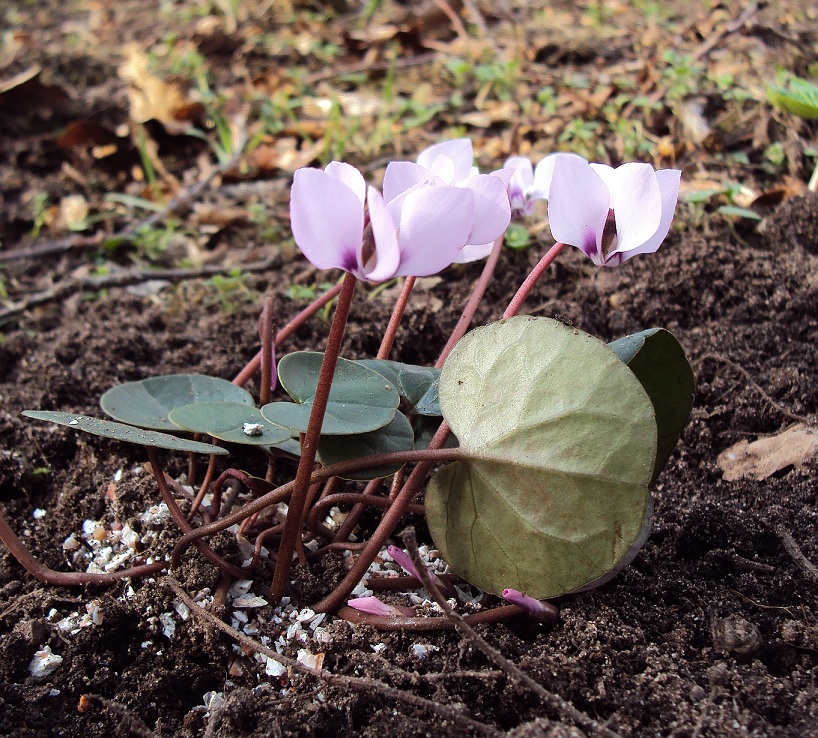


All photographs copyright © 2012 Steve Webb - Used by kind permission.

The height of cyclamen coum is about 8cm and spread 10cm.

It is recommended that these gorgeous plants should be mulched annually with leaf mulch to prevent tubers drying out in the summer and protect from winter cold.

Unless you buy a named variety, the flower colour can vary from white to deep red. Plant the tubers 3cm to 5cm (1in to-2in) deep in humus-rich soil under the shade of trees. Mulch annually with leaf mould to help prevent the tubers from drying out in the summer and from winter cold. This plant has been given a Award of Garden Merit (AGM), which is for plants of outstanding excellence.

Medicinal history and folklore:


WARNING: THIS INFORMATION IS PRESENTED FOR HISTORICAL / ENTERTAINMENT PURPOSES ONLY! WE MAKE NO CLAIMS WHATSOEVER FOR THE EFFICACY OF THE REMEDIES. SOME OF THEM MAY BE HARMFUL. MESS AROUND WITH YOUR BODY AT YOUR OWN RISK!


Andrea Mattioli, a prominent physician and writer who devoted many years to publishing various editions in numerous languages of his translations of the Discourses of Dioscorides. In his 1559 edition in Italian, Chapter CLI II is devoted to cyclamen.


MATERlA MEDICINAL DISCOURSES FROM DIOSCORIDES
BY PIETRO ANDREA MATTIOLI - 1559
DEL ClCLAMINO - Cap. CLIII

Cyclamen has ivy like leaves, purplish, varied, with some spots on the top and white underneath. The stem is about four inches long and bare. On top are the flowers, red, rose like. The root is black, squashed, similar to a turnip.
Among the prescribed uses of cyclamen were the following:
It is said that pregnant women will abort if they walk over it.
If one wears it on herself, it speeds up delivery.
It can be drank to counteract any kind of poison, but especially the sea air.
As an ointment, it is good against serpent's bite.
Taken with wine, it makes one drunk.
It should be taken with wine or honey wine diluted with water for bile overflow in the proportion of three drams. It is necessary, however, to put the patient in a warm place with no drafts and well covered so that he will be able to sweat and the sweat will come out yellow like bile.
The juice of the root can be absorbed through the nose to purge the head.
Applied with honey to the eyes, it is good for cataracts and eye weakness.
The juice of the squeezed roots is cooked until it thickens like honey. The root purges and cleanses the skin; it cures and prevents blemishes and boils.

Taken alone or with honey, it heals wounds.

As a plaster, it dissolves the spleen; it does good to a sunburned face; and it makes hair grow again.

The decoction is good for dislocated limbs, gout, head ulcers, and chilblains. The old oil in which the root was fried makes ulcers heal. One can make a hole in the root and fill with oil and cook it on hot ashes. Sometimes they add Tirrenian wax so that it becomes similar to an oint-ment, especially effective with chilblains.
Somebody says that mashed into a paste it can be used as a love potion.
Centuries later, Gerard in his Herbal says - 'it is reported to me by men of good credit, that cyclamen or sow-bread groweth upon the mountains of Wales; on the hills of Lincolnshire and in Somerset-Shire. Being beaten and made up into trochisches, or little flat cakes, it is reputed to be a good amorous medicine to make one love, if it be inwardly taken'.

In modern herbals, Cyclamen are described as a 'Self-esteem builder essence', which allows the person to get in touch with their self-esteem and confidence. In addition to this rather vague reference, there are a number of more specific applications:
A homoeopathic tincture is made from fresh tubers and is applied as a liniment externally over the bowels, causing purging.
There is a story that in the past the tubers were baked and made into little flat cakes which were considered a good amorous medicine which caused the person eating them to fall violently in love.
The fresh tubers, bruised, and made into a cataplasm, make a stimulating application to indolent ulcers.
An ointment called 'Ointment of Arthainta' was made from the fresh tubers for expelling worms, and was rubbed on the umbilicus of children and on the abdomen of adultsto cause emesis, and in the region over the bladder to increase urinary discharge.
The popular name 'Sowbread' comes from the fact that the tubers were a source of food for wild boar.

There is a report that Cyclamen are poisonous to cats and fish.
In white magic circles, Cyclamen are listed as a plant which brings happiness.

If you thought from last months 'Plant of the Month entry' Snowdrops have an enthusiastic following, then you haven't seen anything yet! Pay a visit to The Cyclamen Society's Website at http://www.cyclamen.org where you will find out everything you could ever wish to know about Cyclamen (including some fascinating reports of expeditions to locate a particular speciman).
  
You can also read the reports by clicking here. They are highly recommended reading.

So there you have it, folks. The not-so-humble Cyclamen coum and friends. Come and visit them at Castle Bromwich Hall Gardens!


Wikipedia

The last word is left to Henry Alford:

Play on, thou little fount of blameless joy,
Freshening our souls through many a weary time;
Gladdening the stately hours of high employ,--
As blest in Britain's mists, as erst in happier clime.


Thanks to:

Gordon Sammons and Sue Brain for inspiration and assistance;
SteveWebb for the fanastic photographs;
Wikipedia;
BBC;
and The Cyclamen Society.

For the full text of On a Cyclamen by Henry Alford, click here.

31/01/2012

Plant of the Month - February 2012

Snowdrop

Lone flower, hemmed in with snows and white as they
But hardier far, once more I see thee bend
Thy forehead, as if fearful to offend,
Like an unbidden guest. Though day by day,
Storms, sallying from the mountain-tops, waylay
The rising sun, and on the plains descend;
Yet art thou welcome, welcome as a friend
Whose zeal outruns his promise! Blue-eyed May
Shall soon behold this border thickly set
With bright jonquils, their odours lavishing
On the soft west-wind and his frolic peers;
Nor will I then thy modest grace forget,
Chaste Snowdrop, venturous harbinger of Spring,
And pensive monitor of fleeting years!

William Wordsworth - To a Snowdrop - 1819


Galanthus nivalis from Flora von Deutschland, Österreich und der Schweiz, Prof. Dr. Otto Wilhelm Thomé 1885

Our second plant of the month signals the transition between the cold bleak Winter and the expectation of Spring. It is the Snowdrop, known as Galanthus (Greek translation gála "milk", ánthos "flower"). It is a small genus of about 20 species of bulbous herbaceous plants in the Amaryllis family, subfamily Amaryllidoideae.


Galanthus nivalis 2005 
Photo: Wikipedia - Creative Commons Licence

Other common names include Candlemas bells, Mary’s taper, snow piercer, February fairmaids and Dingle-dangle. Snowdrops have strong traditional links to churches and Christianity. Snowdrops were the symbol of Candlemas, the Feast of the Purification of the Virgin Mary which is celebrated on February 2nd. Traditionally any woman who wanted to warn off a man would just send him an envelope containing a few snowdrop blooms!

For St. Francis the snowdrop was an emblem of hope, and the touch of green on the inner petals has often been seized upon as a symbol of spring’s return. It is uplifting to see the green sword-shaped leaves piercing the snow and the apparently fragile bell-shaped flowers resisting all that winter can hurl at them.

Mrs. M Grieve, in her book 'A Modern herbal' (1931) describes snowdrops thus:

"The bulbs grow in compact masses. Each sends up a one-flowered stem. The points of the leaves protecting the flower-head are thickened and toughened at the tips, enabling them to push through the soil. This simple device shows on the mature leaf like a delicate nail on a green finger.
The flowers remain open a long time; the bud is erect, but the open flowers pendulous and adapted to bees. The perianth is in two whorls, on the inner surface of the inner perianth leaves are green grooves secreting honey - the stamens dehisce, or open, by apical slots and lie close against the style, forming a cone. The stigma projects beyond the anther cone and is first touched by an insect, which in probing for nectar, shakes the stamens and receives a shower of pollen."


Galanthus nivalis
 Photo: Wikipedia

Regarded by many as a wildflower, snowdrops were not recorded as growing wild in the UK until the 1770s. Most colonies are probably garden escapees though it is still thought some may be native, particularly in southwest England. Snowdrops are also native to a large part of Europe, as far north as Brittany, where they grow in damp woods and meadows.

The variety to be found at Castle Bromwich Hall Gardens is Galanthus nivalis, or Common snowdrop. Galanthus nivalis is a dwarf bulbous perennial of a height of 12cm/ 4 ½ and is fully hardy. This lovely plant consists of strap shaped green/grey leaves. Gorgeous nodding flowers of 3 white outer tepals and 3 smaller inner ones marked with green usually. The period of interest of Galanthus is February to early March, and the flower is often fragrant of honey. It has reliably early white drop like flowers with a green dot or spot. Several garden cultivars exist some with larger flowers than the species, some with double flowers, as well as some later flowering varieties.


Galanthus nivalis at Castle Bromwich Hall Gardens - Lower Wilderness 31st January 2012.
 Photos: Graham High

Our snowdrops are currently located in the lower wilderness in the outer deciduous beds:


Illustration: www.cbhgt.org.uk

There are also hundreds of cultivated varieties of Galanthus around (although not in our gardens) including giant, double and rare yellow kinds, some of which can change hands for significant sums of money. Yellow Galathus can be seen by clicking on this link.

Snowdrops are suitable for growing in borders, meadows, woodlands, and containers. They should be grown in a lightly shaded location in moist, cool soil such as equal parts of loam and compost or peat moss and sand. Plant the bulbs 3 or 4 inches deep and 2 or 3 inches apart in the fall. They look best when planted at least three or four plants together. Water Snowdrops well while they are blooming. Snowdrops can be difficult to establish in the garden and may take a couple of years to adjust to the new site, but, eventually, they will form large, compact groups.


A Cluster of Snowdrops.
 Photo: Wikipedia

The Galanthus genus is poisonous throughout due to concentration of alkaloids, three of which have only recently been discovered by science. Recent research suggests that the plant has potential applications in treatments for Alzheimer's disease. Click here for the full story. Home made remedies involving Galanthus as an ingredient should be avoided as they are potentially harmful.

The subject and growing of snowdrops can develop into an obsession. Such people are labelled Galanthophiles. More interesting is the folklore around the plant which survives to this day. The white flowers are regarded by some as highly unlucky when brought indoors. Some people also view snowdrops as ‘death-tokens’, and the flower has been described as ‘a corpse in its shroud'. This belief may have an anti-Catholic history to it, which in itself is an interesting topic for future research.

So there it is, the humble Snowdrop or Galanthus. Hopefully this page will be a useful source of information to you when you visit the Gardens this month. The plant is small in stature but large in beauty and folklore. Not bad for a February Fairmade...

 Snowdrop, illustrated by Nellie Benson, from  A Flower Book by Eden Coybee, 1901.

Recommended Further Reading:

Brickell, Christopher (ed.): The Royal Horticultural Society Gardners' Encyclopedia of Plants and Flowers, Dorling Kinderseley 1995,  ISBN 0 7513 0147

The Wikipedia entry for Galanthus is most useful, and provides a valuable reading list / jumping off point for further study and research: http://en.wikipedia.org/wiki/Galanthus

The BBC have a great little Snowdrop webpage available at:  http://www.bbc.co.uk/nature/life/Galanthus_nivalis

There are a number of technical papers linking the ingredients found in Snowdrops and the possible treatment of Alzheimer's Disease. Lots can be found by searching on your local web search engine, but please be aware you will usually be required to pay to read articles from Scientific Journals.

Grateful thanks to:
Castle Bromwich Hall Gradens Trust - Gordon Sammons for his invaluable contributions, and to Sue Brain for practical assistance.
ask.com
BBC


Creative Commons Licence

The photographs taken by Graham High in this work are licensed under a Creative Commons Attribution-NonCommercial 2.0 UK: England & Wales License

14/01/2012

Plant of the Month - January 2012

Holly

Blow, blow, thou winter wind,
Thou art not so unkind
As man's ingratitude;
Thy tooth is not so keen,
Because thou art not seen,
Although thy breath be rude.
Heigh ho, sing heigh ho, unto the green holly;
most friendship is feigning, most loving mere folly:
Then, heigh ho, the holly!
This life is most jolly. 

Freeze, freeze, thou bitter sky,
That dost not bite so nigh
As benefits forgot:
Though thou the waters warp,
Thy sting is not so sharp
As friend remember'd not.
Heigh ho, sing heigh ho, unto the green holly:
most friendship is feigning, most loving mere folly:
Then, heigh ho, the holly!
This life is most jolly.

Heigh Ho, The Holly by William Shakespeare


Our first ever Plant of the Month is traditionally associated with Christmas, yet is at its absolute prime at the Gardens at this time of year. I refer of course to Holly, otherwise known as the genus Ilex. The genus has 400 - 600 species, and can be found in temperate zones throughout the world.

Franz Eugen Köhler, Köhler's Medizinal-Pflanzen. Public Domain.

The Royal Horticultural Society's Gardeners' Encyclopedia of Plant and Flowers describes Ilex as a:

'Genus of evergreen or deciduous trees and shrubs, grown for their foliage and fruits (berries). Mainly spherical berries, ranging in colour from red through to yellow and black, are produced in Autumn, following insignificant, usually white flowers, borne in spring. Almost all plants are unisexual, and to obtain fruits on a female plant a male also needs to be grown.' (p.518).


Common Holly (Ilex aquifolium) flowers; male above, female below. 
Photo: MPF - Wikipedia

We'd hesitate before calling the flowers 'insignificant' ourselves, but that's opinion for you. Anyway, Holly does best in a well drained soil, with deciduous and variegated varieties being particularly partial to sun or semi-shade. 

Holly grows in enormous abundance at Castle Bromwich Hall Gardens. The Holly Walk would just be a 'Walk' without it, and our Maze would be far less of a challenge! Here are some of the varieties to be found in the Upper and Lower Wilderness areas:

In the Lower Wilderness you will find:


Ilex aquifolium 'Bacciflava' ( Yellow-fruited holly)

'Bacciflava' is an evergreen shrub or tree with dark green spiny leaves in autumn,spring,summer and winter. Has white flowers in spring and summer, and gorgeous light yellow berries in autumn and winter. Grows to a height between 4-8 metres and spread up to 4 metres. It looks ideal planted in beds and flower borders, and screen/hedging.


Ilex x altaclerensis 'Golden King' (Golden King)

'Golden King' is a bushy shrub or tree and has broad ovate, slightly spiny leaves, with a margin of bright yellow. The flowers appear in spring and summer, are small and are dull white. The berries appear in autumn, winter and are brownish-red. 'Golden King' can take up to 50 years to reach a height of 8 metres.

Meanwhile, in the Upper Wilderness, you can find our old friend:


Ilex aquifolium ( Common Holly)

Aquifolium is a lovely medium sized green tree. It has gorgeous dark green spiny strong leaves. Aquifolium bears white flowers in spring which are followed by bright beautiful red berries which are pollinated on the female parts of the plant. This plant loves the full sun.

This variety makes the walls of our wonderful Maze:

Photo: Castle Bromwich Hall Gardens Trust

Moving onto our spectacular Holly Walk, you'll find that this is comprised of yet another variety of Ilex:


Ilex aquifolium 'Argentea Marginata' ( Silver-margined holly)

'Argentea Marginata' is a bushy medium sized evergreen of conical outline with a height higher than 12 metres and spread of 4 to 8 metres. Has spiny, undulated leaves and is boldly edged with cream and green colour in autumn, winter and summer and has a trace of pink in spring. Flowers small, dull white, with bright red berries in autumn and winter. Ideal for north,east,south and west facing locations and is great grown as a hedge or on its own.

The main problems that Holly face are provided by the Holly Leaf Miner, and / or the Holly Aphid.

Holly is can be propagated by seed in spring or by semi-ripe cuttings in late summer.

Batty Langley in his 1727 book New Principles of Gardening described the raising of Holly thus:

'The wild or green holly is usually raised from its berries, which must be gathered when ripe, and afterwards sweated before they are put in sand, as I have already directed: In which operation care must be taken, that they do not heat over-much in the sweat, for thereby it often happens, that they become useless, which greatly disappoints the diligent planter.' (p.153)


The berries of various species are slightly toxic to humans, although its poisonous properties have been exaggerated and poisoning deaths are almost unknown. Berries attract birds that eat them after the frosts have reduced toxicity.

Several holly species are used to make caffeine-rich herbal teas in various countries, we do not condone or recommended this.

With that brief warning we conclude our brief investigation of Ibex (other than to say if you visit the Gardens, you will experience the beauty of these varities first-hand). We leave the final word to Batty Langley:

'This plant makes an excellent hedge in either Garden, Wilderness, or common Field, and a good fence against Cattle: 'Tis a tree as will grow in the Drip or Shade of Forest Trees, and is a beautiful Plant in the Quarters of a Wilderness or Thicket: Its leaves are always beautiful, and the berries afford a most delightful and agreeable prospect in most months of the year.'

Recommended Further Reading:

Brickell, Christopher (ed.): The Royal Horticultural Society Gardners' Encyclopedia of Plants and Flowers, Dorling Kinderseley 1995,  ISBN 0 7513 0147

Langley, Batty: New principles of gardening: or, The laying out and planting parterres, groves, wildernesses, labyrinths, avenues, parks, &c. after a more grand and rural manner, than has been done before:with experimental directions for raising the several kinds of fruit-trees, forest-trees, ever-greens and flowering-shrubs with which gardens are adorn'd. To which is added, the various names, descriptions, temperatures, medicinal virtues, uses and cultivations of several roots, pulse, herbs, &c. of the kitchen and physick gardens, that are absolutely necessary for the service of families in general..,  1727. Reprinted by Gale ECCO ISBN 978-1170-10633-4, or available as a free ebook from Google Books:
http://books.google.co.uk/books/about/New_principles_of_gardening.html?id=sOk1AQAAIAAJ&redir_esc=y

The Wikipedia entry for Holly is also most useful, and provides a valuable reading list / jumping off point for further study and research: http://en.wikipedia.org/wiki/Holly

Shirley Wynne, Circa. 1880s - Public Domain

Grateful thanks to:
Castle Bromwich Trust Gardeners Gordon and Steve, without whose generous assistance this entry would not have been either written or illustrated!
,
Creative Commons Licence

The photographs taken by Graham High in this work are licensed under a Creative Commons Attribution-NonCommercial 2.0 UK: England & Wales License